Aika.
The bear who belonged
to two worlds.
A polar bear, a little girl, and a man with a camera spent five months on an island at the edge of the habitable world. They returned with a film that asked whether fear had taught us to misunderstand the creatures we call dangerous.
Before words,
look closely.
The animals, their young, and the quiet language of attention.
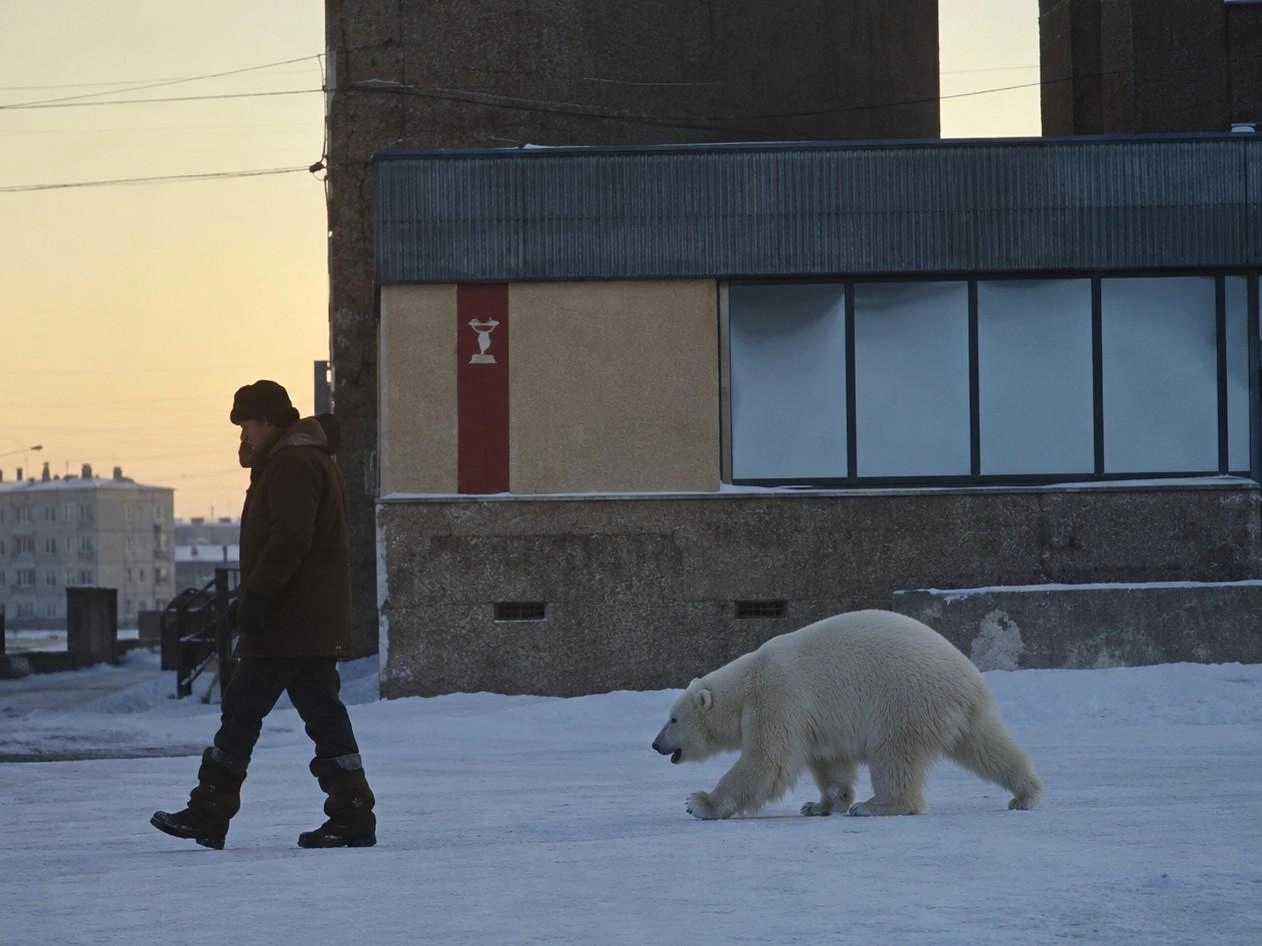
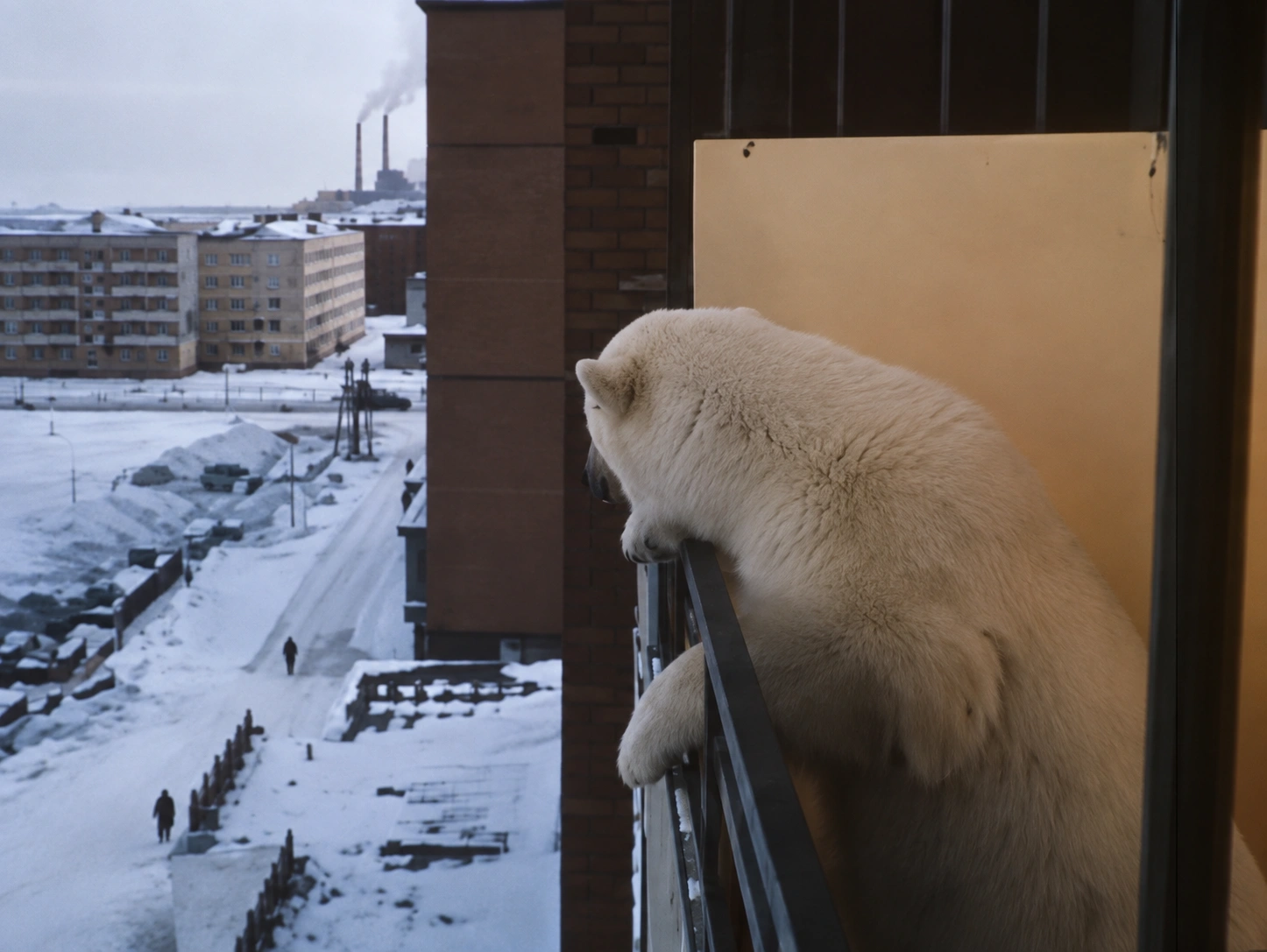
 Norilsk after the expedition. A young polar bear moves among the people who came to know her.
The familiar
excuse.
There was once a sovereign of the north, enormous, milk-white, and known to children from the pictures on their sweet wrappers. The polar bear was called the lord of the Arctic; yet the world had already begun to count how few such lords remained.
Travellers described a savage beast. Laws protected it, and still the killing continued — invariably, it seemed, in self-defence. Ledin's film begins with that small, almost casual excuse. Then the narrator does something rather marvellous: he begins at the end. In a snowy city, a bear follows a man through the street. Her name is Aika; to her, the man and his family are home.
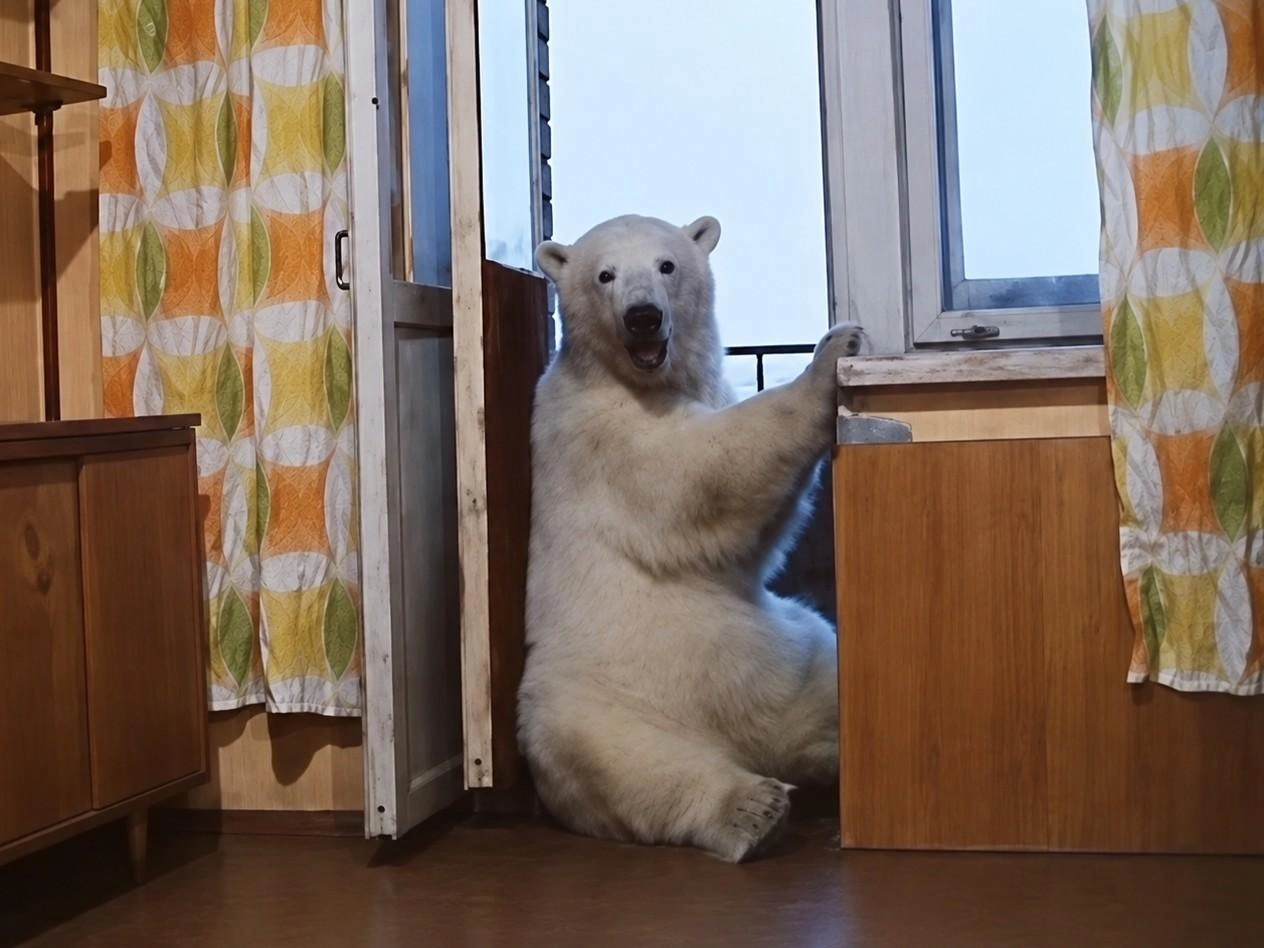
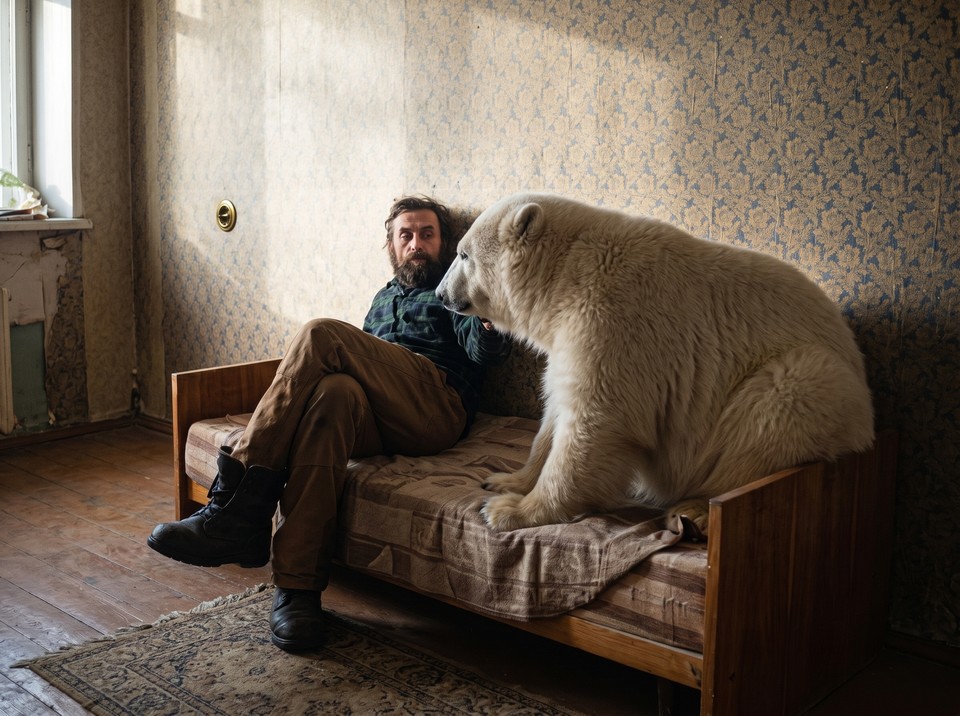 In a Norilsk apartment, Aika rests on the bed beside a member of her human family.
The little
sister.
Aika was born beside the Black Sea, in a zoo where her mother could not rear her. Human hands took the place of paws. Yuri and Lyudmila Ledin became her parents; their daughter Veronika, the film insists with gentle precision, was not another mother but a sister — and certainly not an elder one.
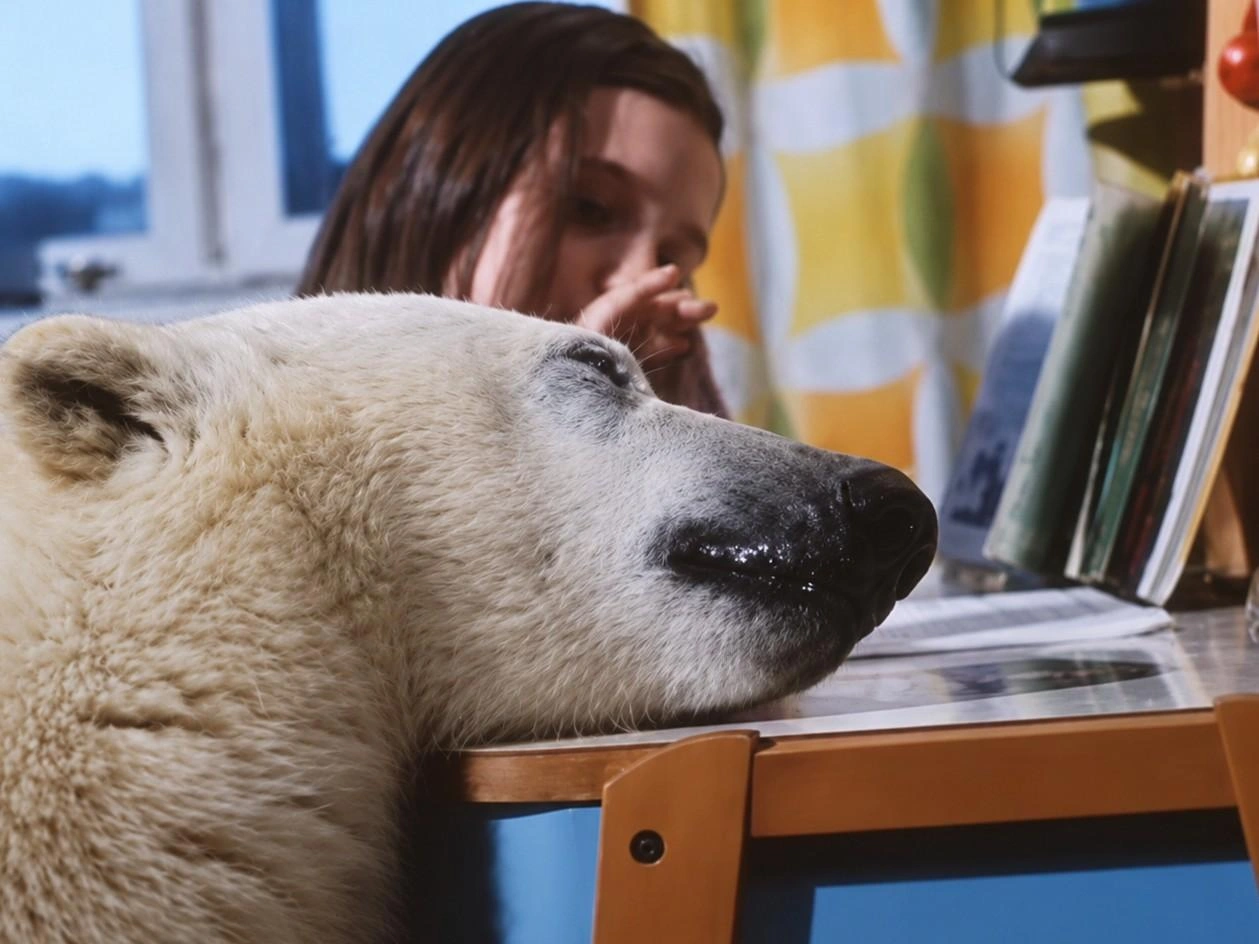
There were curtains patterned like flowers, a balcony above the winter streets, books upon a table, and the astonishing white head resting beside them. Aika belonged to this household with all the innocent certainty of childhood. Beyond its windows waited another inheritance: the ice.
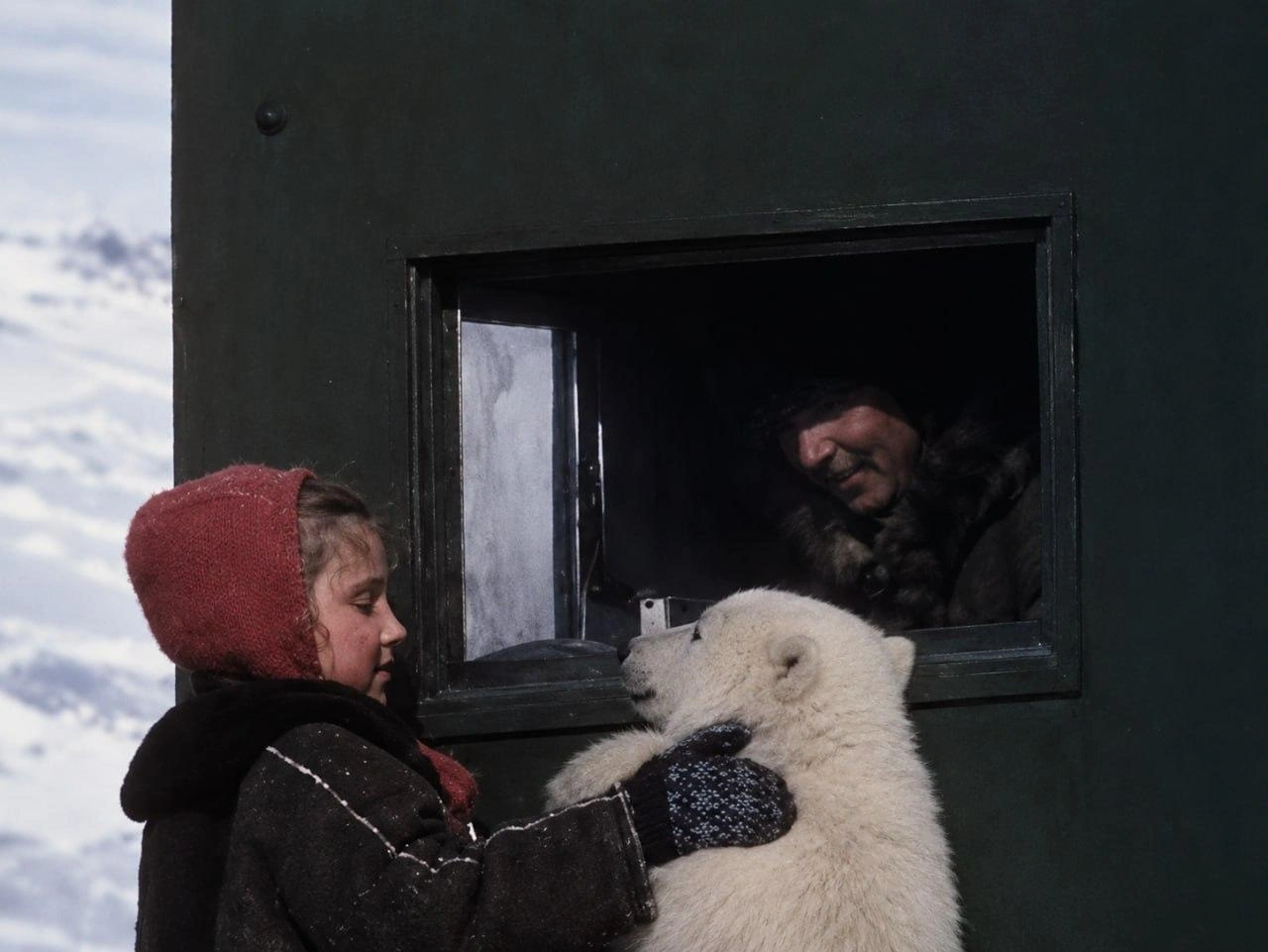 The expedition's two small shelters on Champ Island, where five months of Arctic life were about to begin.
North of
everything.
In May 1974, at five months old, Aika flew towards the land of her ancestors. The family chose Champ Island in Franz Josef Land, built two little shelters and prepared to spend five months making a film. For an entire month, no wild bear appeared.
Aika, meanwhile, outgrew her porridge. A seal was brought for her first lesson in the food of polar bears, but its hide was more than her young teeth could manage. She could play with Veronika; she could not yet feed herself upon the ice. One sort of childhood had taught her affection. The other remained unwritten.
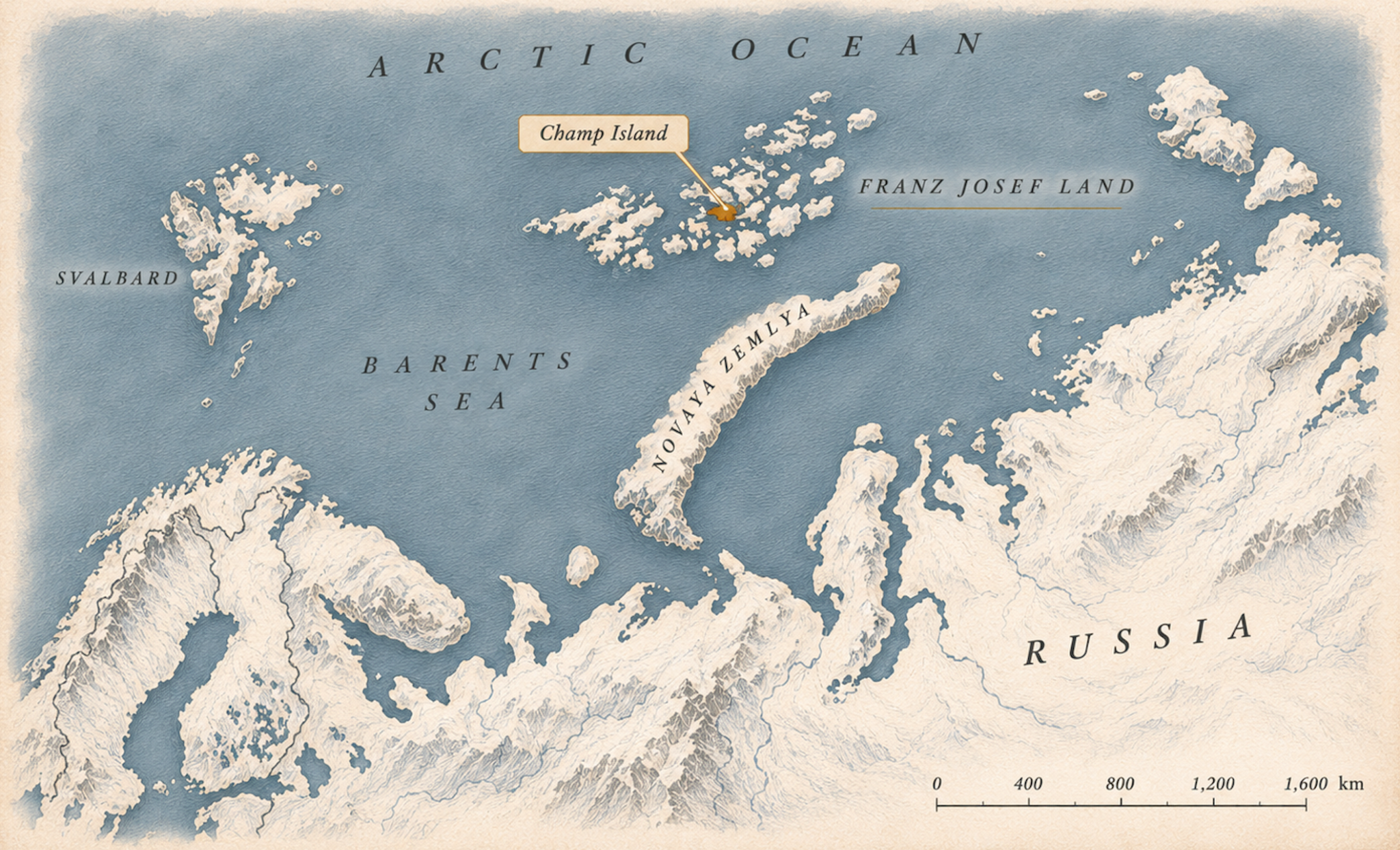
The Arctic Ocean.
Between Svalbard and Novaya Zemlya lies the far northern archipelago that drew Yuri Ledin and his family across the sea.
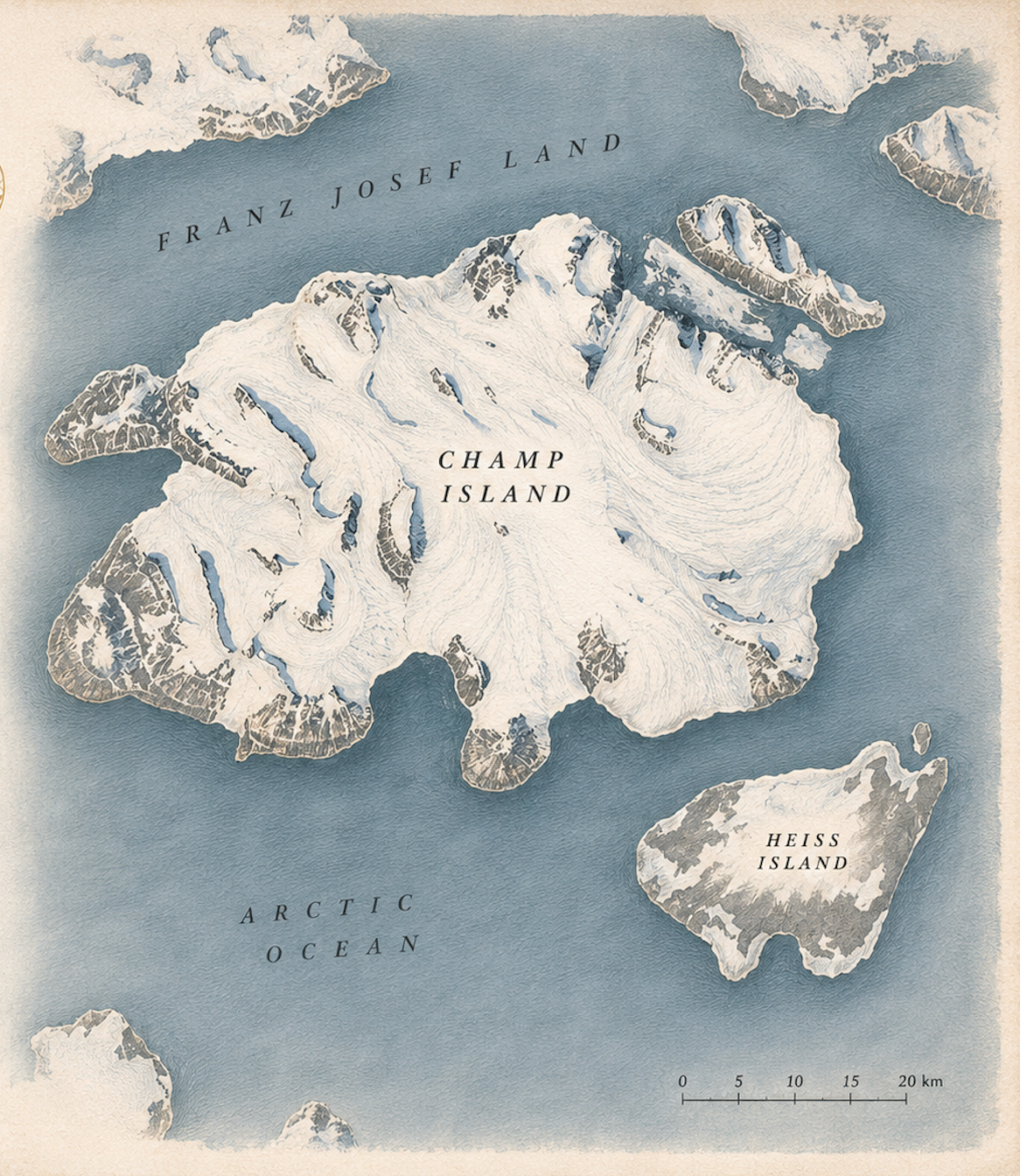
Champ Island.
Two prefabricated shelters rose upon the island. Here Aika would encounter bears who belonged wholly to the ice.
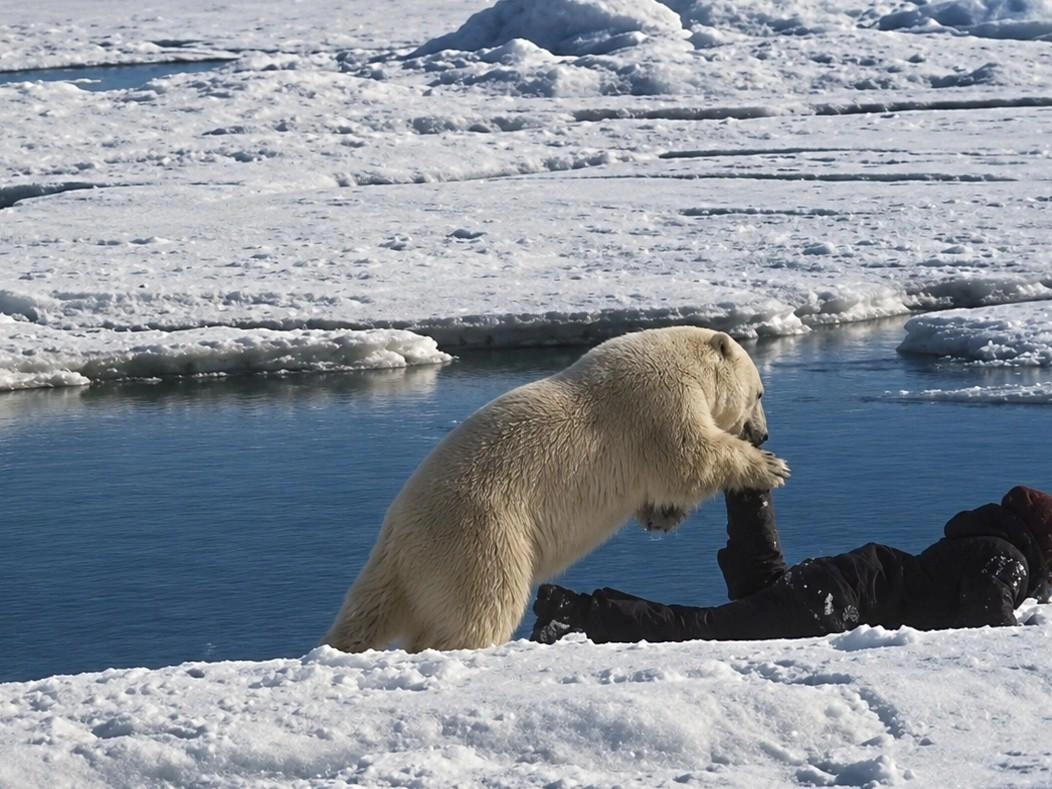
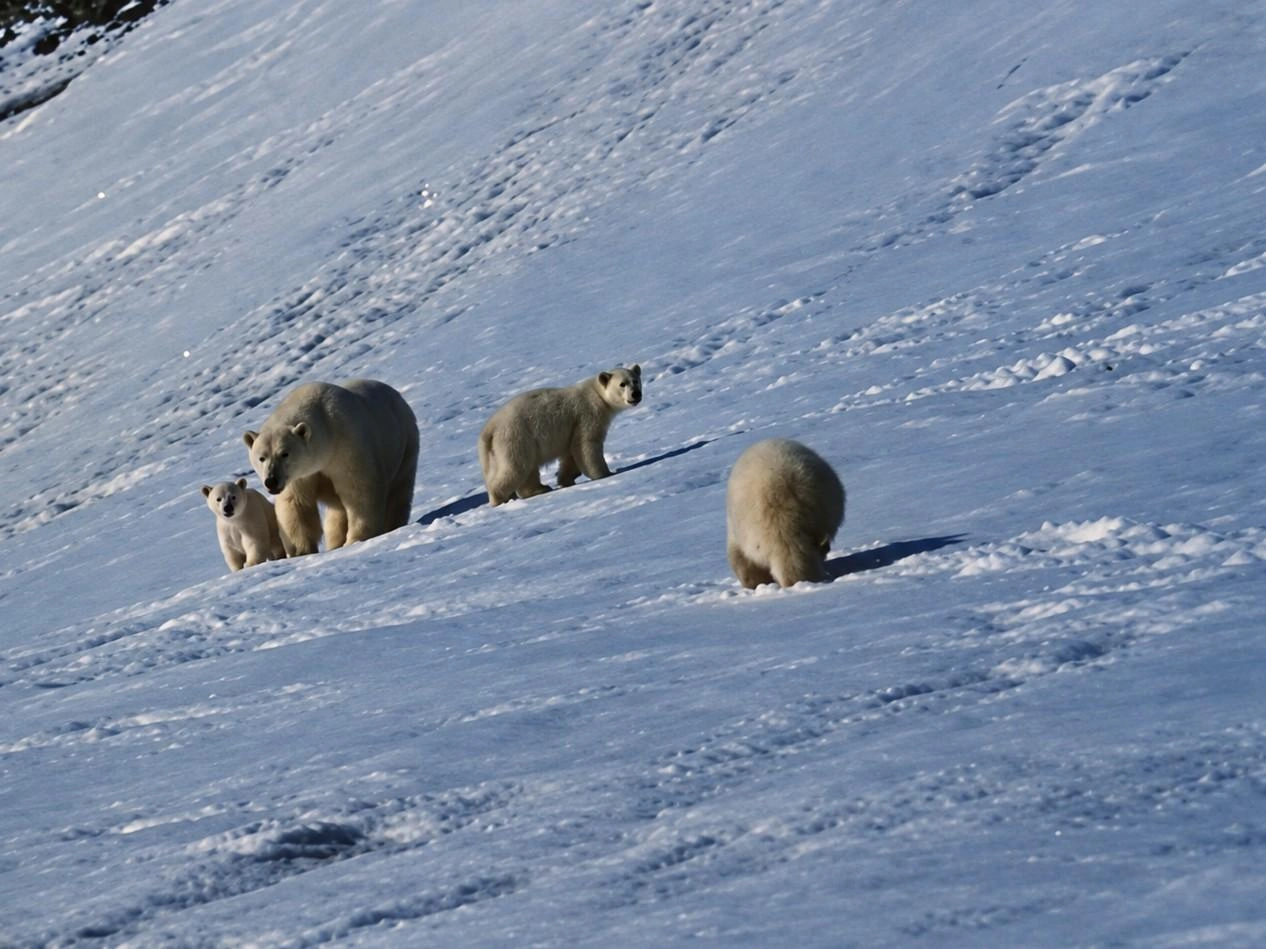 An archival image of a wild polar bear with cubs; the animals are not independently identified as Matilda's family.
The mother
of the ice.
At last a female appeared, accompanied by two cubs. One was thin, though no younger than Aika. Their mother had to find seals beneath water whose dark openings changed from day to day. Every failure meant hunger, and she had two small lives to nourish.
When the filmmakers approached, she made a sudden movement: not an attack, but a warning. They were afraid — naturally. Yet fear, the narrator observed, was not a command to kill. Before them stood the mightiest predator on land, intent chiefly upon keeping her children alive.
To be afraid of a bear was natural.Literary rendering of the film's reflection on self-defence
To kill one was not thereby inevitable.
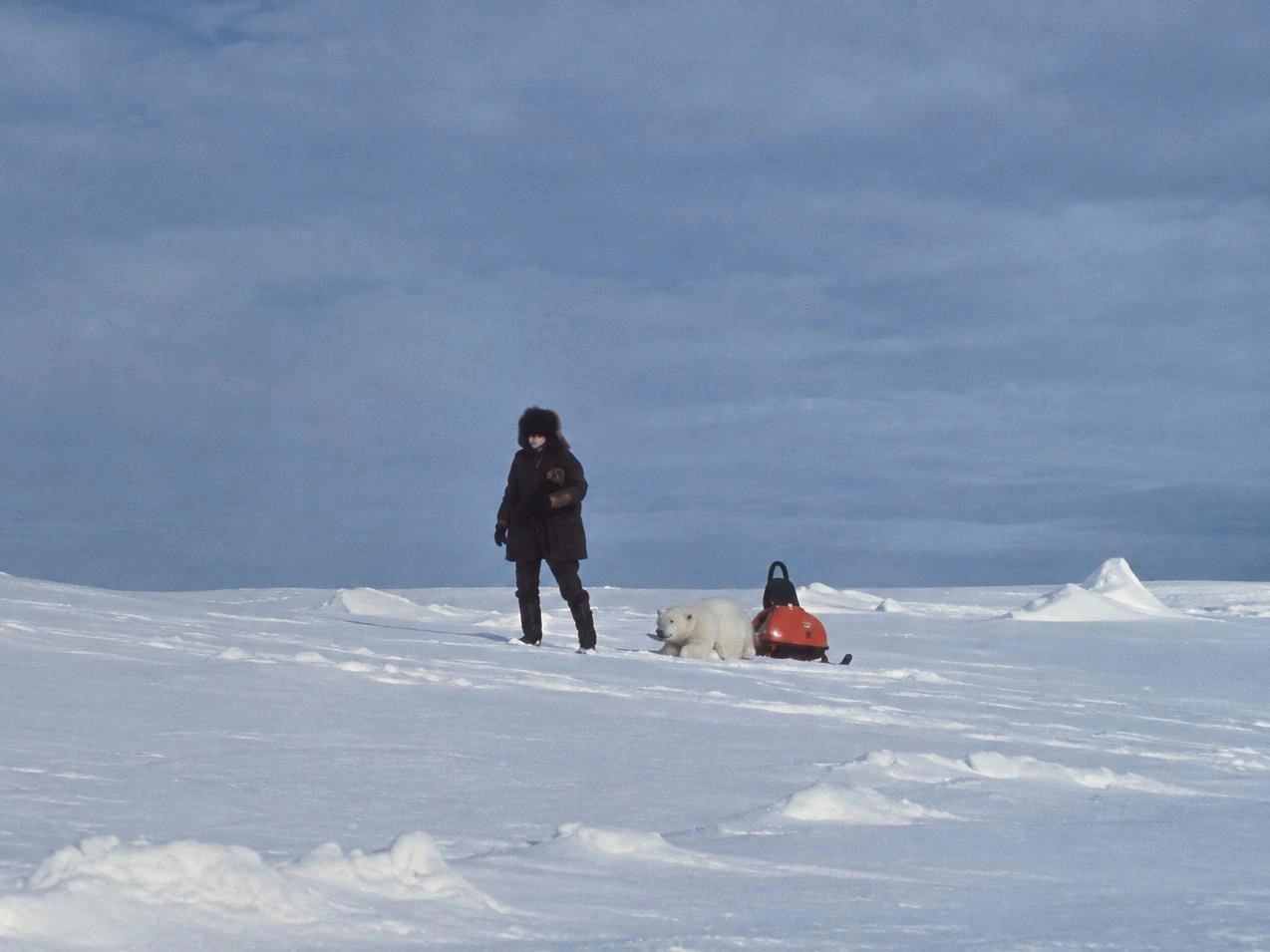 The expedition's snowmobile. Twenty kilograms of pork, hidden underneath it, were eventually given to Matilda, the wild mother of two cubs.
The visitor
called Matilda.
They gave the wild mother a name: Matilda. She took a seal offered near the camp and, in a gesture the filmmakers read as trust, dragged it closer to their shelter. That confidence did not extend to Aika. Matilda had two cubs; she wanted no third.
Aika followed the strangers, and Veronika was forbidden to call her back. She returned of her own accord. On 19 July, sixteen days after their departure, Matilda's family reappeared — not, the narrator dryly noted, because they had missed anyone, but because they remembered the food. A quarrel at the door ended with twenty kilograms of pork in Matilda's possession. The visitors had become very expensive neighbours.
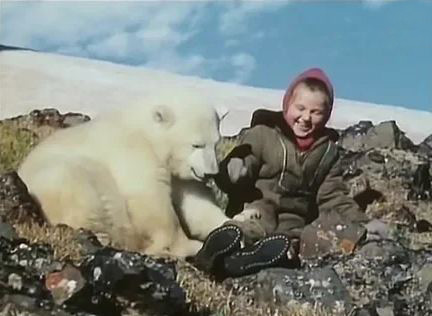 Veronika and Aika among the rocks of Champ Island — an intimacy the Arctic could not teach.
The danger
of kindness.
For a while two families inhabited the same strip of Arctic shore. Their young remained strangers to one another. Aika, the bear raised among people, guarded her human home against bears who were entirely at home in the wild.
The offerings had an unforeseen result. Matilda's family began waiting for meals rather than hunting. Human kindness had quietly made life more difficult for the animals it intended to help. When Matilda returned with a seal, she showed her cubs how to pull it ashore. Aika watched a lesson that no one had ever been able to give her.
A mother
with cubs.
To find food and keep her young alive: that was her daily occupation.
A girl
and a bear.
Veronika was the sister Aika knew; hunting was the lesson no one could teach her.
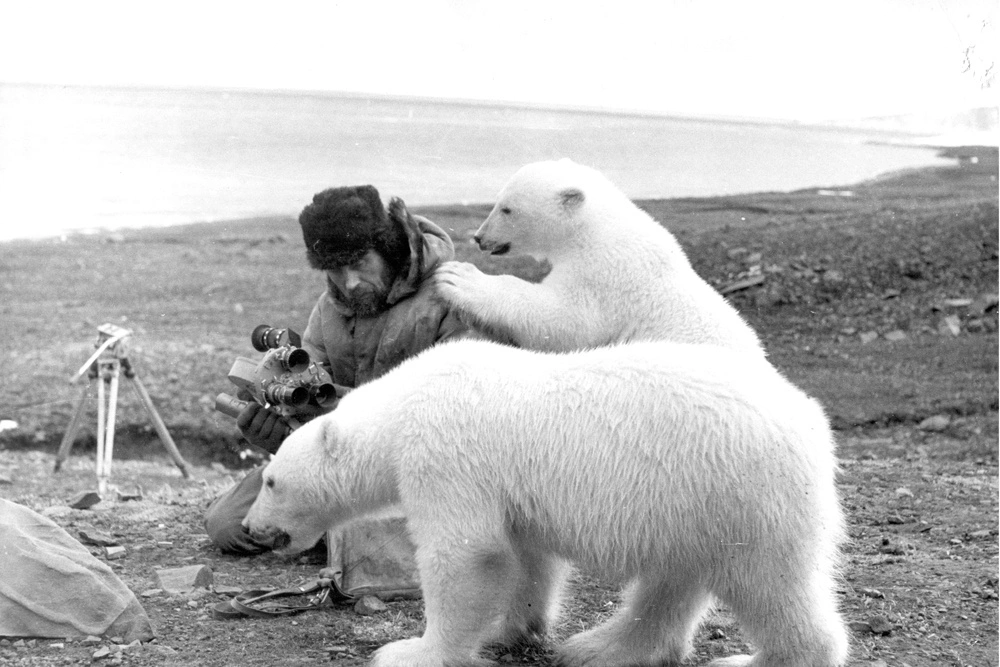
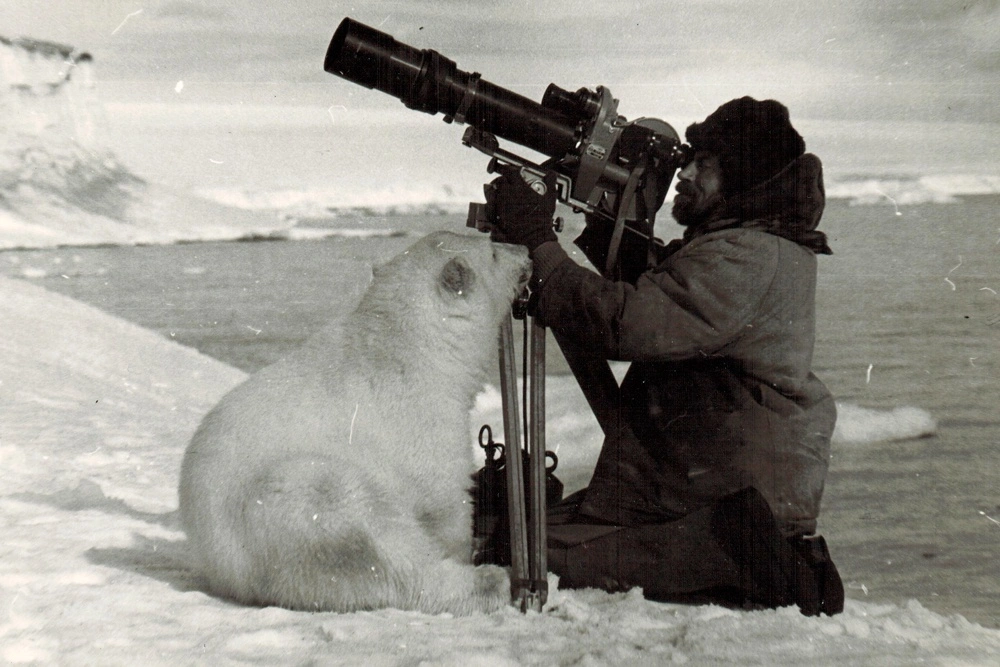 An Arctic filmmaker at work beside a polar bear. Archival expedition photograph.
The last
Arctic light.
September came. Other bears crossed the island, and none received a particularly warm welcome. Aika stood guard over the shelter; Matilda kept her young close. Even among their own kind, the Arctic offered no easy fellowship.
It became clear that Aika could not simply remain. She had learnt the voices of her family, but not the arts by which a bear survives alone. The departure approached like the end of a summer dream. The island would keep its ice, its seals, and Matilda with her cubs; the little bear would go back with the people she loved.
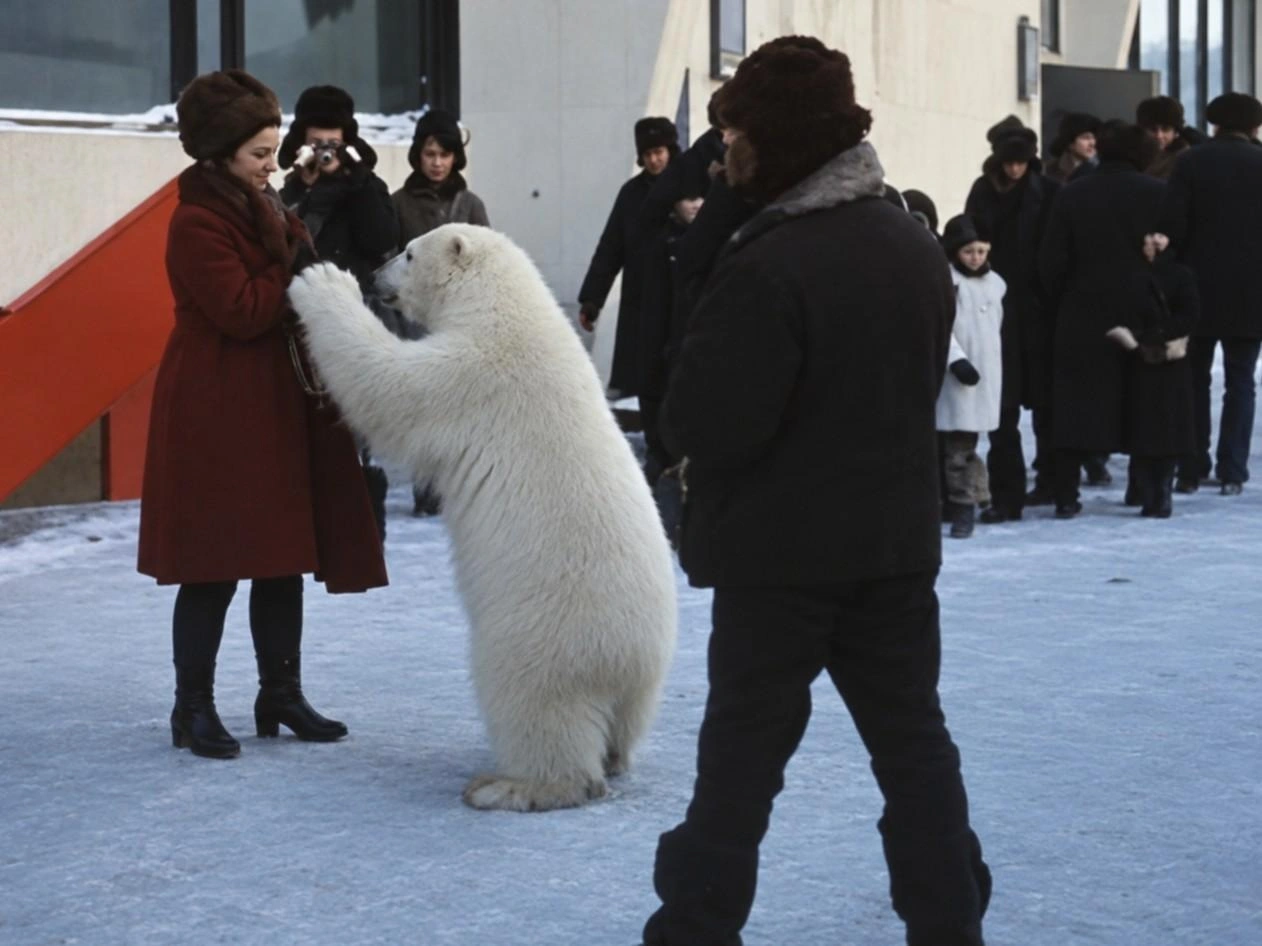 Aika greeting a familiar person: a living answer to the film's final words.
A room,
a white skin.
At the end, the camera leaves the island and returns us to a comfortable room. Somewhere, on a floor, lies the skin of a polar bear; somewhere, a man offers the customary explanation.
But we have watched Matilda feed her young, warn rather than attack, and learn to tolerate her unusual neighbours. We have watched Aika defend a home that was not, in nature's eyes, hers at all. The film has not made wild bears harmless. It has made them impossible to dismiss.
And if, in some comfortable room, we see the skin of a polar bear, we shall remember Champ Island and Matilda with her cubs. And we shall no longer believe anyone who tells us that this mighty creature, the lord of the Arctic, was killed in self-defence.Literary English translation of the film's closing narration, from the supplied Russian transcript
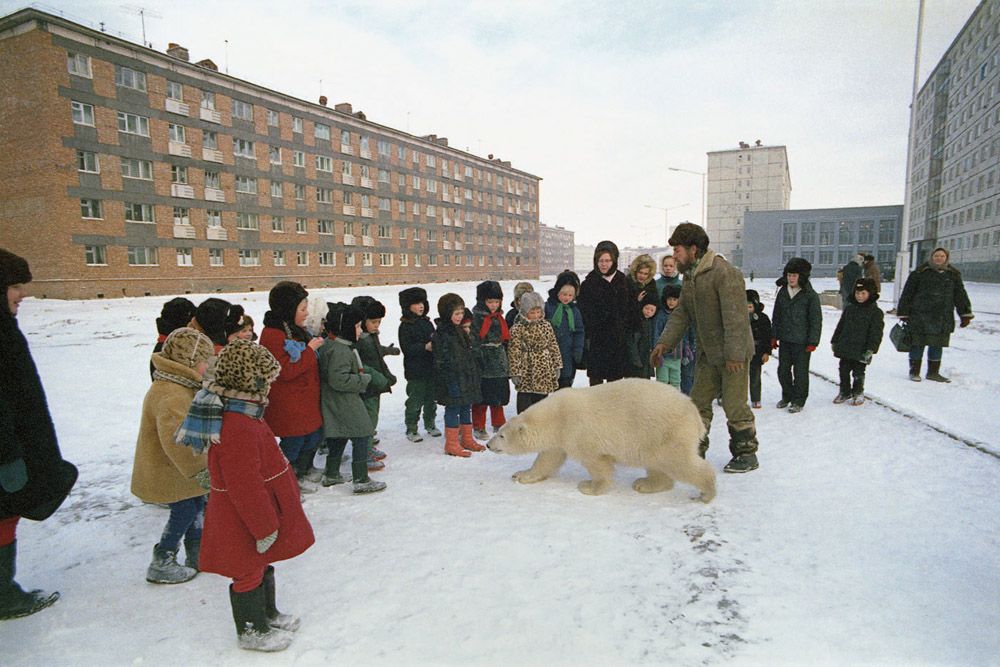
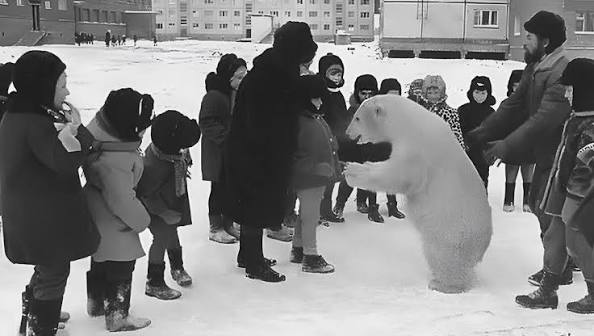 Norilsk after the expedition. Children gather around Aika in a snow-covered courtyard.
What the
camera kept.
The film's extraordinary tenderness lies in its refusal to mistake an animal for either a monster or a miniature human being. The bears had feelings and purposes of their own: maternal vigilance, curiosity, fear, affection, the desire to live.
And there is Aika once more, walking behind a familiar figure through the snow. The camera cannot keep a summer from ending. It can, for an instant, keep its light.
The Polar Bear.
Watch the complete documentary with its original audio. Playback starts when you press play.
Complete film · Original Russian audio
Words to hear
with the snow.
Listen to the original documentary soundtrack as you read. Or leave the silence undisturbed.
Optional audio · The film's original narration and sound, not a separate instrumental album.
Sources and notes
The chronology and documentary scenes in this essay are based primarily on the Russian automatic transcript of Yuri Ledin’s The Polar Bear (1975), supplied for this feature, including the film’s opening and final narration, the 19 July return of Matilda, the feeding episodes and the last month in September. The opening portion of the supplied transcription also includes retrospective commentary from other speakers; statements about Ledin’s approach to animals are presented as recollections, not invented direct quotations. Literary translations are not certified verbatim English subtitles; minor transcription errors may remain.
Additional biographical background: NGS24 and Yuri Ledin’s biography. Photographs supplied for the article are reproduced as provided and retain their original colour. Exact dates and individual photographic credits are not established for every frame. Trust or proximity between humans and individual bears must not be mistaken for evidence that wild polar bears are safe to approach or feed.
The last chapter
What love
could not keep.
There was another departure, and this one had no homecoming. Aika was sent to a zoo in Germany, far from the island, far from the rooms and voices she had come to know. There she died.
For Yuri Ledin, the separation did not end with her death. In later years he spoke of the feeling that he had betrayed her, abandoned a creature who had trusted him. What remained was not simply grief, but a question he carried through his life: how much of an animal's love do we recognise, and how readily do we disregard it?
His reflections reach beyond one bear and one family. They ask us to look at the living world not as a possession, but as a home shared with beings who can fear, remember and form attachments. To love nature is also to answer for what we do to it.
Aika is gone. The question she left us with is not.